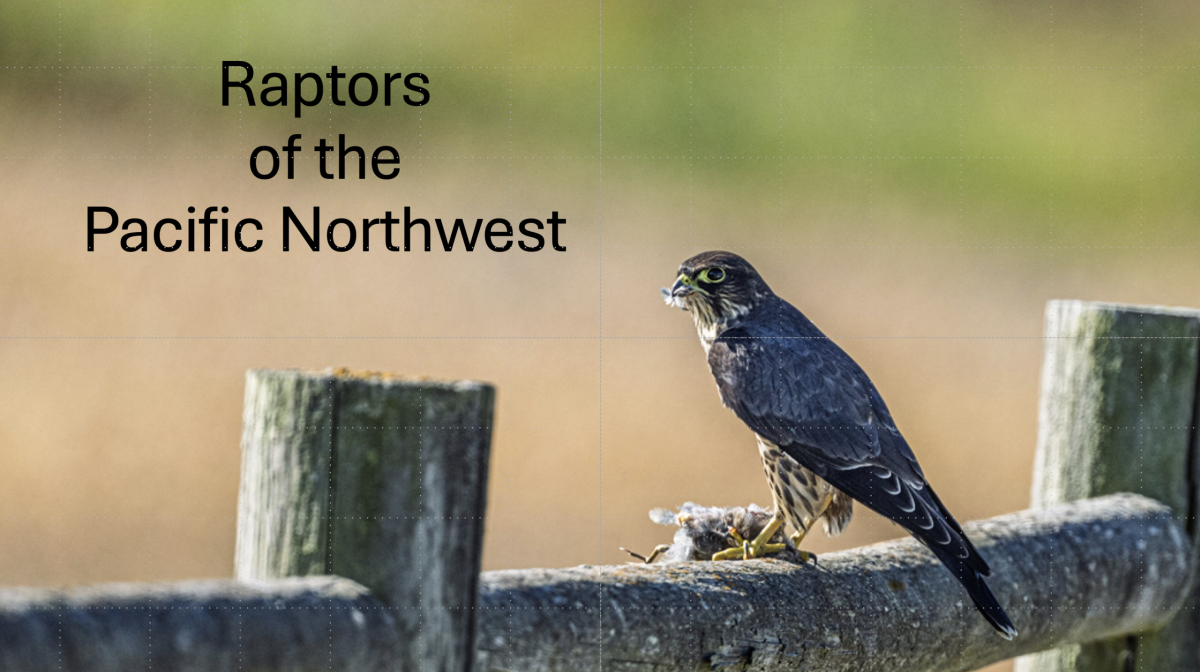
Raptors of the Pacific Northwest
About Course
A hawk flashes across the road. A large raptor circles high overhead. A falcon streaks past before you can get your binoculars on it. How do you figure out what you just saw?
Raptors are among our most exciting birds—and sometimes among the most challenging to identify. Nineteen species of diurnal raptors regularly occur in the Pacific Northwest, from massive Golden and Bald Eagles to American Kestrels and Sharp-shinned Hawks.
This free course is designed to help you learn to see raptors, not simply memorize field marks. Your brain is already remarkably good at recognizing people you know from their shape, size, movements, voice, and surroundings. We’ll apply those same skills to birds.

You’ll learn to first place an unfamiliar raptor into a broad group—eagle, hawk, falcon, vulture, harrier, or kite—and then use several clues together to work toward the species. We’ll study:
Shape and size • Behavior • Color patterns • Habitat and distribution • Calls
Short lectures introduce the ideas and identification skills. Interactive reviews give you a chance to practice them, and self-graded quizzes let you test yourself without worrying about a score. We’ll also explore the natural history of these remarkable birds.
And because the best way to learn raptors is to go find them, I’ll show you online and print resources for discovering where raptors are being seen throughout the Pacific Northwest and provide several self-guided raptor field trips you can download and try yourself.

By the end of the course, my hope is that when a raptor appears, instead of thinking “I don’t know what that is,” you’ll know what to look for, what questions to ask, and how to work toward an identification.
The course is free. Come learn raptors with me.
Course Content
Section 1 — Getting Started: Learning to See Raptors
-
Learning to See Raptors
14:13 -
Finding Raptors and Learning More
16:05
Section 2 — The Tools of Identification
Section 3 — Buteos
Section 4 — Accipiters & Harriers
Section 5 — Falcons
Section 6 — Eagles, Vultures, Kites & Owls
Section 7 — Putting It All Together
Student Ratings & Reviews


